Why most Retirement Plans fail after the First 5 Years
A lot of retirement plans look solid in the beginning, but the cracks show up sooner than expected. This post shows the real reasons behind those setbacks.
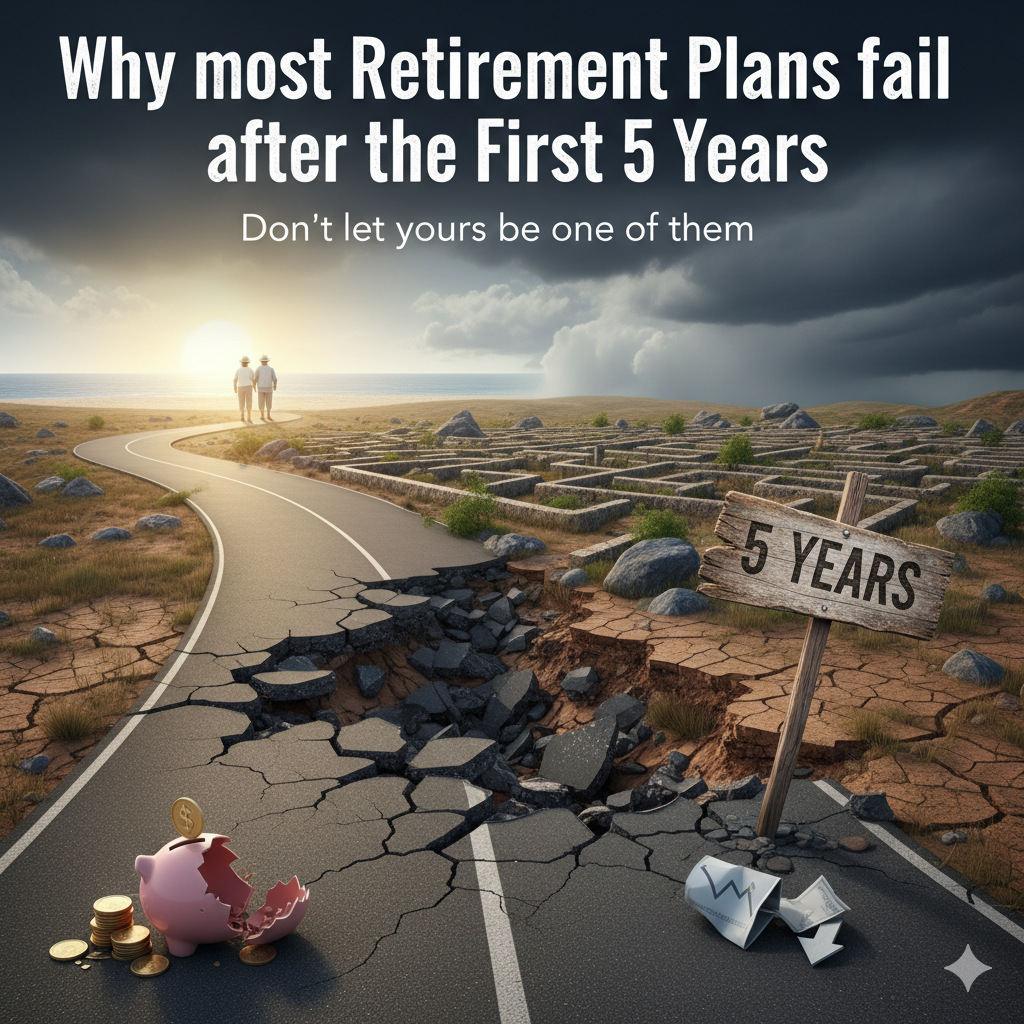
Early retirement sounds like the finish line. No alarm clocks, no meetings, no asking for permission to live your life. Yet a surprising number of people who reach financial independence quietly return to work, downgrade their lifestyle, or feel stuck only a few years later.
The issue is not that FIRE is a bad idea. The issue is that most FIRE plans are built for spreadsheets, not for real life.
Understanding why many plans fail after the first five years can save you from making the same mistakes and help you design a version of financial independence that actually lasts.
The First Years Feel Easy and That Is the Trap
The early phase of FIRE often feels smooth. Expenses are controlled, portfolios look healthy, and markets may cooperate. Confidence is high.
This is exactly when retirement problems begin to form.
Most FIRE plans are optimized for the accumulation phase. They focus heavily on saving rates, investment returns, and target numbers. Far fewer plans are stress tested for long term withdrawals, changing expenses, or emotional fatigue.
The first five years expose these weaknesses because reality starts to diverge from projections.

Withdrawal Strategies Look Better on Paper Than in Real Life
Many FIRE plans rely on simplified withdrawal assumptions. A fixed percentage, stable returns, and predictable expenses.
Real life does not behave this way.
Markets fluctuate. Inflation changes spending power. Unexpected costs appear. Healthcare expenses alone can derail even conservative projections.
When withdrawals are too aggressive early on, portfolios may survive in good years but struggle during downturns. This sequence risk is one of the most common reasons FIRE plans collapse quietly rather than dramatically.
The danger is not a single bad year. It is several average years combined with poor timing.
Lifestyle Drift is subtle but Powerful
Most people underestimate how their lifestyle evolves after leaving full time work.
At first, spending often drops. Commuting costs disappear. Work related expenses fade. Time feels abundant.
Then life expands.
More travel. More hobbies. More social activities. Better food. Higher expectations for comfort. None of these are excessive on their own, but together they increase spending slowly and consistently.
This drift is rarely accounted for in original retirement calculations. The result is a growing gap between planned and actual expenses.
Healthcare Is the silent Budget Killer
Healthcare is one of the least predictable costs in early retirement.
Plans often assume stable insurance costs or minimal usage. Reality is different. Coverage changes, premiums rise, and medical needs increase with age.
Even small increases compound over time. What starts as a manageable expense can become a major drain on cash flow within a few years.
This uncertainty makes rigid retirement plans fragile. Flexibility matters more than precision.
Identity shock is real and underestimated
Leaving work is not just a financial change. It is an identity shift.
Many people underestimate how much structure, purpose, and social interaction work provides. When that disappears, the emotional impact can be significant.
Some retirees feel lost. Others feel pressure to justify their decision. Some fill the gap with spending or risky investments. Others return to work not for money, but for meaning.
This psychological adjustment is rarely planned for, yet it directly affects spending behavior and decision making.
Overconfidence after success leads to risky Choices
Reaching FIRE creates confidence. Sometimes too much of it.
After years of disciplined saving and investing, it is easy to believe future decisions will be just as rational. This mindset can lead to concentrated investments, speculative moves, or ignoring diversification.
When markets reward this behavior, confidence grows further. When markets reverse, the damage is often severe.
Long term financial independence requires humility, not just skill.
Taxes do not stay static
Many FIRE plans assume tax efficiency will remain stable. In reality, tax rules change, personal situations evolve, and retirement withdrawal strategies may become less optimal over time.
Early retirees often discover that taxes eat more than expected once income sources shift. Capital gains, required distributions, and state level differences all matter.
Without periodic tax planning, small inefficiencies compound into meaningful losses over time.
The plan lacks built in flexibility
Rigid plans break. Flexible plans adapt.
The most resilient FIRE strategies allow for adjustments. Temporary income. Variable spending. Changing withdrawal rates. Lifestyle redesign.
Plans that assume everything will go exactly as modeled are the ones most likely to fail quietly after a few years.
What Actually Works Long Term
Successful FIRE retirement plans share common traits.
They include conservative withdrawal assumptions. They account for rising healthcare and lifestyle costs. They include optional income streams, even if they are not needed initially. They prioritize adaptability over optimization.
Most importantly, they treat early retirement as a chapter, not an ending.
People who thrive long term use financial independence to design a meaningful life, not to escape work at all costs.
Final Thoughts
Most FIRE retirement plans do not fail because people miscalculated a number. They fail because life changed.
Markets move. Expenses evolve. People grow.
A plan built only for reaching FIRE is incomplete. A plan built for staying there is far more valuable.
If your goal is true freedom, not just an early exit, then realism, flexibility, and self awareness matter as much as saving and investing.
Financial independence and retirement are not about quitting work forever. It is about building a life that can sustain itself, financially and personally, for decades to come.
And that is worth planning for properly.
The information provided in this article is for informational and educational purposes only and does not constitute financial, legal, or investment advice. While efforts are made to ensure accuracy, Retire ASAP makes no guarantees regarding completeness or applicability to individual circumstances. Readers are encouraged to consult a qualified professional before making any financial decisions.