Public Pensions vs Private Pensions: Which retirement plan is better?
Public and private pensions both promise security, but they work in very different ways. Before choosing a path, it’s worth understanding what each one really offers. This post breaks it down so you can decide which one fits your future.
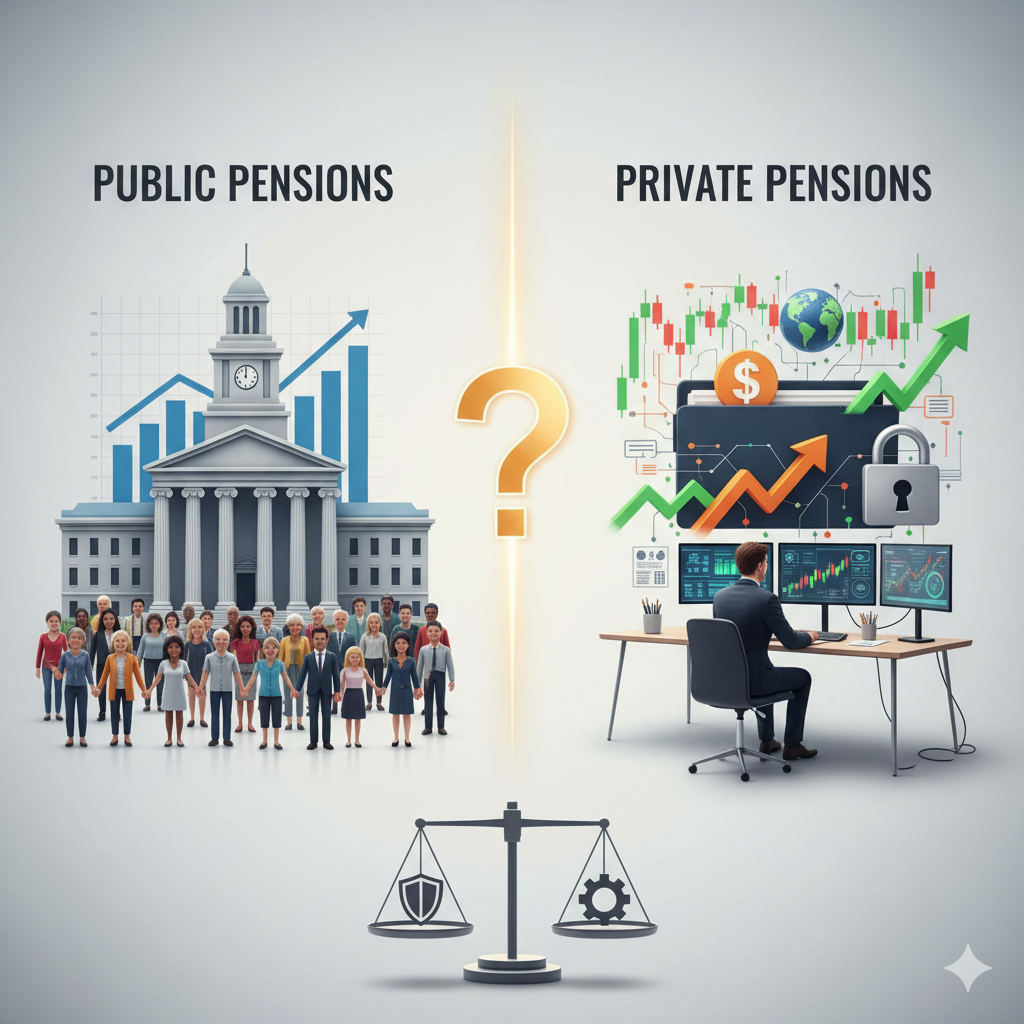
When Americans think about retirement, two types of pension systems usually come up: public pensions and private pensions. While both are designed to provide income after you stop working, they operate very differently.
Understanding how each one works is especially important for people pursuing financial independence and early retirement (FIRE). The right strategy can affect how stable your retirement income is, how much flexibility you have, and how early you can realistically stop working.
So which option is better? The honest answer: it depends on your career, goals, and how much control you want over your money.
Let’s break it down.
What is a Public Pension:
A public pension is a retirement plan funded and managed by government entities. In the United States, these plans typically apply to government employees, such as teachers, firefighters, police officers, and other public-sector workers.
Public pensions are usually defined benefit plans. That means the retirement income is based on a formula rather than on investment performance.
A common formula might look like this:
Years of service × salary × benefit multiplier
For example, someone who worked 30 years with a benefit multiplier of 2% could receive roughly 60% of their final salary every year in retirement.
One of the most well-known public pension systems in the U.S. is Social Security, although most government workers receive both Social Security and an additional pension plan.
Advantages of Public Pensions
Public pensions offer several benefits that many private retirement plans no longer provide.
Predictable lifetime income
You receive a steady monthly payment for life. This makes retirement planning simpler.
Protection from market volatility
Your pension amount is not directly affected by stock market swings.
Potential survivor benefits
Many plans allow payments to continue to a spouse after death.
Inflation adjustments
Some public pensions include cost-of-living adjustments (COLA), helping payments keep up with inflation.
These features create a level of financial stability that can be very appealing.
Drawbacks of Public Pensions
Despite their stability, public pensions have some limitations.
Limited flexibility
You generally must work a certain number of years before qualifying for full benefits.
Delayed retirement age
Many public pension systems require employees to work until their late 50s or 60s to receive maximum benefits.
Dependence on government funding
Some pension systems face funding challenges due to rising liabilities and demographic changes.
For people interested in retiring very early, these restrictions can make public pensions less flexible.
What Is a Private Pension?
Private pensions are retirement plans offered by private-sector employers or created by individuals themselves.
Traditional private pensions used to be defined benefit plans, similar to public pensions. However, over the past few decades, most companies have shifted toward defined contribution plans.
The most common examples include:
- 401(k) plans
- Individual Retirement Accounts (IRAs)
- SEP IRAs for self-employed workers
In these systems, employees contribute money from their paychecks, and employers sometimes provide matching contributions.
Instead of receiving a guaranteed payment, your retirement income depends on how much you save and how well your investments perform.
Advantages of Private retirement plans
Private retirement plans offer something that public pensions usually cannot: flexibility and control.
Investment control
You can choose how your money is invested, often through index funds, mutual funds, or ETFs.
Portability
If you change jobs, your retirement account typically moves with you.
Early retirement potential
Since you control withdrawals, you may be able to retire earlier than traditional pension systems allow.
Employer matching contributions
Many companies match part of your 401(k) contributions, which is essentially free money toward retirement.
These features make private retirement accounts especially popular among people pursuing FIRE.
Drawbacks of Private Pensions
Private retirement plans also come with risks.
Market volatility
If the stock market performs poorly, your retirement savings could grow more slowly.
No guaranteed income
Unlike public pensions, private plans do not automatically provide lifetime payments.
Requires discipline
You must consistently save and invest over decades to build a strong retirement portfolio.
Many Americans unfortunately contribute too little to their retirement accounts, which can create financial challenges later in life.
Which Retirement plan is better?
The answer depends on what you value most: security or flexibility.
Public pensions offer predictability and stability. If you stay in a government career for decades, they can provide reliable income throughout retirement.
Private retirement plans, on the other hand, offer greater freedom and control. They allow people to build wealth independently and potentially retire earlier than traditional pension systems allow.
For people pursuing early retirement, private investment accounts often play a larger role because they provide access to funds before standard pension ages.
The best strategy: Use both (if possible)
For many Americans, the best retirement strategy is combining multiple income sources.
A strong retirement plan might include:
- Social Security benefits
- A workplace 401(k)
- Individual investment accounts
- Real estate or other passive income sources
Diversifying retirement income reduces risk and increases long-term stability.
For example, someone with both a pension and personal investments may have guaranteed income plus the flexibility to travel, relocate, or adjust spending.
This combination can create a more resilient financial plan.
| Feature | Public Pension | Private Pension (401(k), IRA) | Combination of Both |
|---|---|---|---|
| Type of plan | Usually defined benefit | Usually defined contribution | Mix of guaranteed income and investments |
| Offered by | Government employers (teachers, police, federal/state workers) | Private companies or individual investors | Public pension plus personal investment accounts |
| Income predictability | Very predictable monthly payments | Depends on investment performance | Stable base income plus flexible withdrawals |
| Market risk | Low direct exposure to stock market | Higher exposure to market volatility | Balanced risk through diversification |
| Flexibility | Limited (must meet service and retirement age requirements) | High flexibility and control over investments | Moderate to high flexibility |
| Portability | Usually tied to a specific government job | Portable between jobs and accounts | Pension stays fixed, investments remain portable |
| Early Retirement Potential | Often limited due to age requirements | Possible depending on savings and withdrawals | Higher flexibility for early retirement |
| Inflation protection | Some plans include COLA adjustments | Depends on investment growth | Pension stability plus growth from investments |
| Long-Term security | High if pension system remains funded | Depends on saving discipline and market returns | Often the most balanced retirement strategy |
Why early retirement requires a different mindset
The traditional pension model was designed for people who planned to work 30–40 years in the same career. But the FIRE movement encourages people to build wealth earlier and rely more heavily on investments.
Because of this, early retirees often prioritize:
- Aggressive saving rates
- Low-cost index fund investing
- Tax-advantaged retirement accounts
- Reducing long-term expenses
Even people with pensions often build separate investment portfolios to gain more freedom over their retirement timeline.
Final Thoughts
Public pensions and private pensions both serve the same purpose: providing financial security after your working years.
Public pensions excel at stability and guaranteed income, making them attractive for people who stay in government careers long term.
Private retirement plans offer control, flexibility, and the potential for early retirement, which aligns closely with FIRE strategies.
Rather than thinking of these systems as competitors, it’s more useful to see them as different tools for building financial independence. The more diversified your retirement income sources are, the more secure your future can become.
FAQs
1. What is the biggest difference between public and private pensions?
Public pensions typically guarantee lifetime income based on years of service, while private pensions usually depend on personal contributions and investment performance.
2. Are public pensions disappearing?
Not entirely, but they are becoming less common outside the public sector. Most private companies now use defined contribution plans like 401(k)s instead.
3. Can you retire early with a public pension?
It’s possible, but many public pension systems require long careers before full benefits are available.
4. Are 401(k) plans safer than pensions?
They offer flexibility but carry market risk. Pensions provide predictable income but less personal control.
5. Should I rely only on one retirement plan?
Most financial experts recommend combining multiple retirement income sources for greater long-term security.
The information provided in this article is for informational and educational purposes only and does not constitute financial, legal, or investment advice. While efforts are made to ensure accuracy, Retire ASAP makes no guarantees regarding completeness or applicability to individual circumstances. Readers are encouraged to consult a qualified professional before making any financial decisions.